السبت، 6 نوفمبر 2010

Some shaping fun

Quite awhile ago I mentioned how I wanted to teach Jenny a trick that had her filing down her own nails. Here is some video of one of our training sessions. This video ends when she got distracted by a treat that fell under the stove. There is sandpaper glued to the board and no it isn't bothering her paws. She is holding them so that she is scraping just the nails and not her paw pads.


I also now have a dremel I have been working on getting her used to. I'm finding the noise and vibration of it doesn't seem to phase her at all. It's the taking her paw in my hand that presents the problem. We will need to concentrate on that for a spell. The tricky part of that is I need to make sure she differentiates between a flat hand held vertically in front of her face means touch with her nose and the hand held flat horizontally to the floor means give me her paw. Any mix up means she will be slapping me in the ring for our stand exercise. This is just one example of why clarity in hand signals is important.

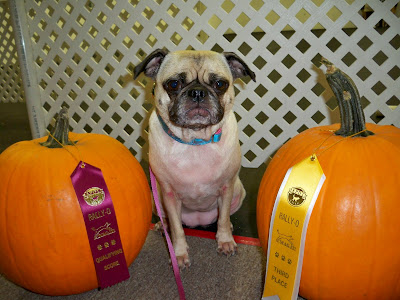
In other news we got our certificate in the mail today for our APDT Rally Level 1 title and our Award of Excellence. She is officially Prone's that's my girl RL1 AOE! Yay Jenny!

Making progress ~ pug health news

Remember a few posts back when I was complaining about the lack of health testing in pugs by pug breeders? Well check this out. There is now a test to see what pugs may be carriers of the gene that causes pug dog encephalitis. From the UCDavis website:

Approximately 1.2% of Pug dogs die of necrotizing meningoencephalitis (NME), also known as Pug dog encephalitis (PDE). NME is an inflammatory disease of the central nervous system that is usually progressive and fatal. Symptoms of NME include seizures, depression, ataxia, abnormal gait and blindness (1). Female, fawn-colored Pug Dogs younger than 7 years of age are more apt to develop NME than older, male and non-fawn colored individuals (2). Recent research has revealed that susceptibility to NME is associated with the dog leukocyte antigen (DLA) region of dog chromosome 12 (3). The association is at or near the region containing the DLA class II genes. Dogs that have two identical copies of the NME associated markers in this region, have an observed risk (OR) of 12.75 for NME in their lifetime over Pugs that have only one or no copies of these markers (OR 0-1.08).

Here is the original site:

http://www.vgl.ucdavis.edu/services/PDE.php

And here is the link to purchase a test kit.

http://www.vgl.ucdavis.edu/services/dog.php

Add this to the list of things that should be checked before breeding a pug. At least in the world according to me.

الجمعة، 5 نوفمبر 2010

Alpha Rolling in Wolves and Dogs

Wanna see a real "alpha roll"?


And here is a video of an alpha roll between 2 dogs.


For a more in depth explanation of alpha rolling see this post. It's hard to believe that people are still using this method on their dogs in the name of training. It's bunk. Spread the word.
*
(Hat tip to Retrieverman for sharing the wolf video.)

الخميس، 4 نوفمبر 2010

If you hike in the woods, please watch this

How to open a coyote leg hold trap.


Unfortunately dogs don't always stay on the safe parts of trails. Thank you Dr. Heather for the information. Hopefully you'll never need to use the info. Please pass this on so it can help others too.

الثلاثاء، 2 نوفمبر 2010

More APDT Rally fun


So Sunday Jenny and I went to another APDT Rally trial at Wag It in Lincolnville. I think we did pretty good. I entered 3 level 1 trials on the road to our rally level 1 excellent title. I figured this would give me extra practice at not getting nervous while I wait to go into the ring before we start trying for our level 2 title. It is only the 4th time we have done a Rally event if you count the AKC match. (I only enter one day of most two day events due to my work schedule and the prison training schedule.)
*
In trial 1 Jenny was distracted and we scored a 197. Trial 2 wasn't much different and we scored a 198. Trial 3 was the last one of the day and I was pretty tired by then. I was to tired at that point for any nerves so maybe that is why we did better and scored a 206 to get a 3rd place ribbon. So that makes 3 qualifying scores towards the 10 we need. Yay for Jenny!
*
I have identified a couple of problems however:
*
One is that I think my hand signals must be slightly different in the ring than out of it. I say that because when I warm her up or practice she does the exercises with no hesitation. Yet those same exercises in the ring has her looking at me like she didn't understand the cue. Then we end up retrying the station. I guess I need to get more video both in and out of the ring to see if I can figure out exactly what it is I am doing differently.
*
The other is that I am becoming to competitive! Not with any of the other teams but with myself. When I get a score I think could have been better I find that I am thinking to much about it. "We can do better than that!" This is supposed to just be fun for us. Something Jenny and I get to do together to show our skills and a chance to socialize with other dog lovers. It is weird because I don't really consider myself a competitive person. I guess the good thing is that it isn't directed at anyone else. I love watching others so I can cheer them on and learn stuff from their runs. And it is just plain entertaining to watch dogs have fun with their people. I also really love that in Rally everyone else is the same way. The camaraderie in the sport is fabulous! And to be honest it is probably part of what keeps me going back for more. It's not like I need to compete in shows after all.
*
I need to stop focusing on high scores and be happy when we get a qualifying score. Period. I think maybe it is because I am a dog trainer. Maybe I'm holding myself to a high standard because I worry how it will look to others. "She's a dog trainer, her dog should get great scores." Which is silly because many of the exhibitors are also dog trainers and I don't think that about their scores at all. (so in theory they probably don't care about my scores either) I guess I need to work on that. But then again maybe it's a good thing. I mean striving to do better isn't all bad is it? (OK I just re-read what I wrote and think I am a greedy idiot. Those are pretty good scores!)
Here she is in between classes relaxing. She doesn't like being alone in the car so I try to give her many breaks and spend time with her frequently. For me part of showing is about spending time with your dog after all. I tried putting her into the soft crate thinking she would be warmer in the smaller space. I draped a blanket over the back of it to keep body heat in as well. When I came out to check her I found her stuck between the window I put it in front of (so she could see where I went) and the crate. Hmmm what's wrong with that picture? Luckily it looks fixable as she only pulled the door out of the zipper. Even if I have to sew that door shut it has a top loading door as well. Lesson learned: use metal fold up crates when leaving her unattended in the future.
*
I think we will start practicing for level 2 more so we can enter level 1 and 2 at trials. This will keep us busier and also works towards our ARCH title. (I think.) FMI on APDT Rally go to www.apdt.com and click on the Rally link. I'm still learning as I go.
And how cute is this? You can find your own at www.magneticpedigrees.com
*
The photo: Honestly, she either looks irritated, grumpy, or scared in most of the photos I take of her. She is so serious all the time. At this point I'm not sure she has a happy face!

Distraction work

I wrote this post Saturday afternoon and then forgot to post it because the other topic took over my head and insisted it be presented first. So just pretend it's Saturday night while you read this.
*
Today Jack got to come help me work at the prison. He did great. Roxy and Gordon made progress in learning how to keep focus on their handlers around a distraction. The distraction being Jack of course.
Gordon and Roxy are distracted by Jack for completely different reasons. Roxy loves other dogs and wants to play with them all. She needs to learn she won't always get to do that. Not all other dogs will want to say hello to her after all. Gordon on the other hand sometimes gets intimidated by other dogs and tries to drive them away with bullying. So for him he needs to learn to be more comfortable when one is around. Using food for classical conditioning and not pushing him beyond his social threshold is important in the beginning.

So even though it is for different reasons they both need the distraction work. This is just one important skill that will help them when they get adopted into a home. No one wants a dog that goes crazy when they pass another dog during their walks together.

They both did well and by the end of the session were lying down with Jack walking past them and vice versa. It will take more sessions with multiple dogs for this to be something they generalize to all other dogs. How the other dog acts towards them will also come into play. I brought Jack because he is non-confrontational and friendly towards other dogs so his body language is appropriate.

If you bring a dog that is threatening towards Gordon for instance he would take much longer to calm down. He would also be less likely to trust what the other dog was doing. I also recommend using the BAT behavior program for dogs that are fearful towards other dogs approaching. It basically teaches the dog that you are listening to them and rewarding them for not getting reactive with a functional reward in that moment. This also helps build the dogs trust in you as the handler.

As always most training is about learning how to communicate with each other. I'm pretty lucky to have Jack as my helper. I'm sure he appreciates the extra treats he gets paid for the work.

(Yes he is tethered in the above photos so I can better direct the handlers but prevent any unwanted contact. I also walked him around on leash as well.)